

Sitework is the first scope on most jobs and one of the easiest places to lose money. Quantities are large, unit costs add up fast, and a lot of what you are pricing is underground or only implied by the drawings. That is why the question of who does the estimating matters: do you build sitework takeoffs with your own estimator, or send the plans to a third-party estimating service?
The honest answer depends on your bid volume, your in-house skills, and how much of the work you self-perform. This guide explains what a sitework takeoff really involves, what each approach costs and delivers, and a simple way to decide. If you want the short version of what we do, see our sitework and earthwork estimation service.
Why Sitework Estimating Is Different From Other Trades
Most trades measure things you can see on a sheet: square feet of drywall, linear feet of conduit, a count of doors. Sitework mixes those direct measurements with quantities that must be calculated from surfaces and elevations. A few reasons it is harder to estimate:
- Volumes come from contours. Cut and fill is calculated by comparing existing and proposed grades. No one prints the number on the plans for you.
- Soil changes volume. Material swells when it is dug and shrinks when it is compacted, so what you dig, what you haul, and what you place are three different numbers.
- Quantities are scattered. They live across grading, utility, paving, erosion control, landscape, and detail sheets, plus the geotechnical report.
- Unknowns carry real risk. Unsuitable soils, groundwater, rock, and existing utilities rarely show up cleanly on the drawings.
- Small errors scale. A modest mistake in a per-yard assumption is multiplied across thousands of cubic yards.
Many earthwork cost surprises trace back to assumptions made at the takeoff stage, long before the first machine arrives. Getting the quantities right, and stating the assumptions behind them, is the foundation of a sitework bid.
What a Sitework Takeoff Actually Covers
Sitework spans several CSI MasterFormat divisions, mainly Division 31 (Earthwork), Division 32 (Exterior Improvements), and Division 33 (Utilities). A complete takeoff usually captures the eight scopes below, each in its own unit of measure.
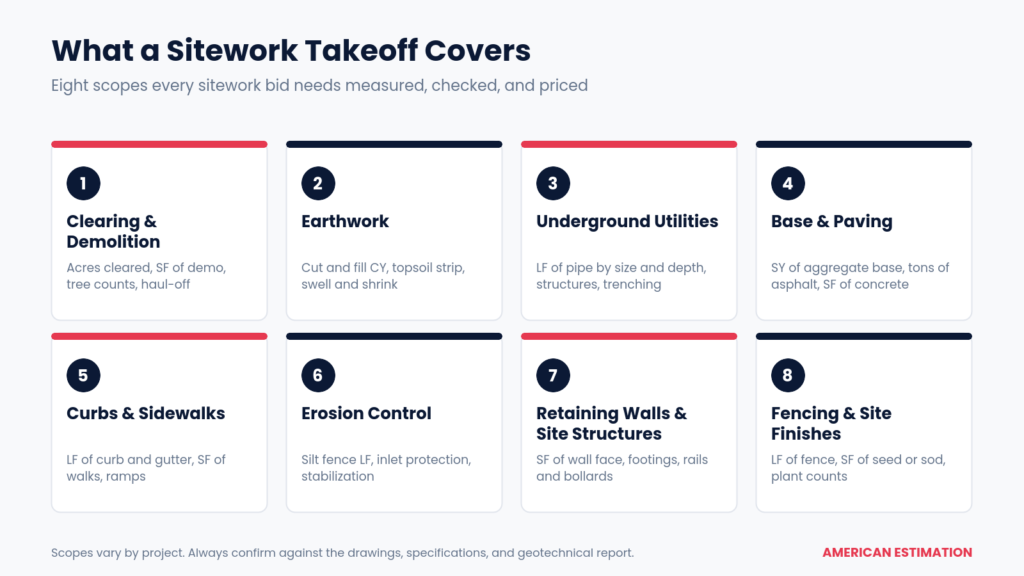
Whoever does the estimating, the deliverable should show quantities by scope with units, plus a clear list of assumptions and exclusions, so you can check every line against the drawings before you price it.
Earthwork: Where Sitework Bids Are Won or Lost
Earthwork usually carries the most uncertainty and the largest swing in cost. The key is understanding the three states of soil:
- Bank cubic yards (BCY): soil in its natural, undisturbed state. Plan-based cut volumes are measured this way.
- Loose cubic yards (LCY): soil after excavation, when it has swelled. This is what fills trucks and drives hauling cost.
- Compacted cubic yards (CCY): soil after it is placed and compacted. Fill requirements are measured this way.
An illustrative example. On a real job, take the swell and shrink factors from the geotechnical report. For this example, assume 25% swell and 10% shrink:
- Cut from the plans: 10,000 BCY.
- Fill required: 8,000 CCY.
- Bank yards needed to build that fill: 8,000 ÷ 0.90 ≈ 8,889 BCY.
- Surplus to export: 10,000 − 8,889 ≈ 1,111 BCY, which is about 1,389 LCY on the trucks (1,111 × 1.25).
If you simply subtract 8,000 from 10,000, you would plan to export 2,000 yards. The adjusted number is very different, and so is the trucking, disposal, and schedule that go with it.
Three Ways to Calculate Cut and Fill
| Method | How it works | Best for | Watch out for |
|---|---|---|---|
| Grid method | Divides the site into squares and averages the difference between existing and proposed elevations in each cell | Quick checks and small to mid-size sites | Coarse grids hide detail; finer grids are more accurate but take longer |
| Average end area | Measures the area of cross-sections at set stations and averages between them | Roads, channels, and other linear work | Needs sensible section spacing; terrain between sections is approximated |
| Surface (TIN) modeling | Builds digital surfaces from contours or survey data and compares them directly | Complex grading, large sites, and phased work | Needs clean CAD or survey data and real software skill |
In-House Sitework Estimating: What You Get and What It Costs
Keeping sitework estimating inside your company works well when the volume and the skills are there. The strengths are real:
- Local knowledge. You know your haul routes, disposal sites, supplier pricing, and typical soil conditions.
- A tight link to the field. Estimators can talk directly with superintendents and equipment foremen about how the work will actually be built.
- Control and confidentiality. Bid information never leaves your office.
- Institutional memory. Lessons from past jobs feed straight into the next bid.
The costs and risks are easier to overlook:
- The full cost of the seat. Wages, payroll taxes, benefits, software, hardware, and training all add up beyond the base salary.
- Specialist skills. Building surface models and checking cut and fill takes practice and the right tools, and not every general estimator has both.
- Uneven workload. Bid volume swings with seasons and backlog, but you pay for the capacity in slow weeks too.
- A single point of failure. If your one civil estimator is out sick or leaves, sitework bidding stalls.
Third-Party Sitework Estimating: What You Get and Where It Falls Short
With a third-party service, you send plans and specifications to an estimating firm and receive itemized quantities and cost estimates back. The advantages:
- Capacity on demand. You can take on more bids without adding headcount.
- Specialist focus. The estimators do civil takeoffs regularly, including earthwork modeling, utilities, and paving.
- Pay per project. Your cost follows your bid volume instead of a fixed payroll line.
- A second set of eyes. An independent takeoff is a useful check on numbers your team produced.
- Less software to own. The provider carries the licenses and the upkeep.
It also has limits you should plan around:
- You still own the pricing. Local rates, crew productivity, equipment, haul costs, markup, and risk allowances stay with your team.
- It needs complete information. A missing geotechnical report or addendum turns facts into assumptions.
- Communication matters. Scope questions close to bid day need quick answers from both sides.
- Quality varies by provider. Vet the firm before you rely on it for a bid that matters.
How the Costs Behave
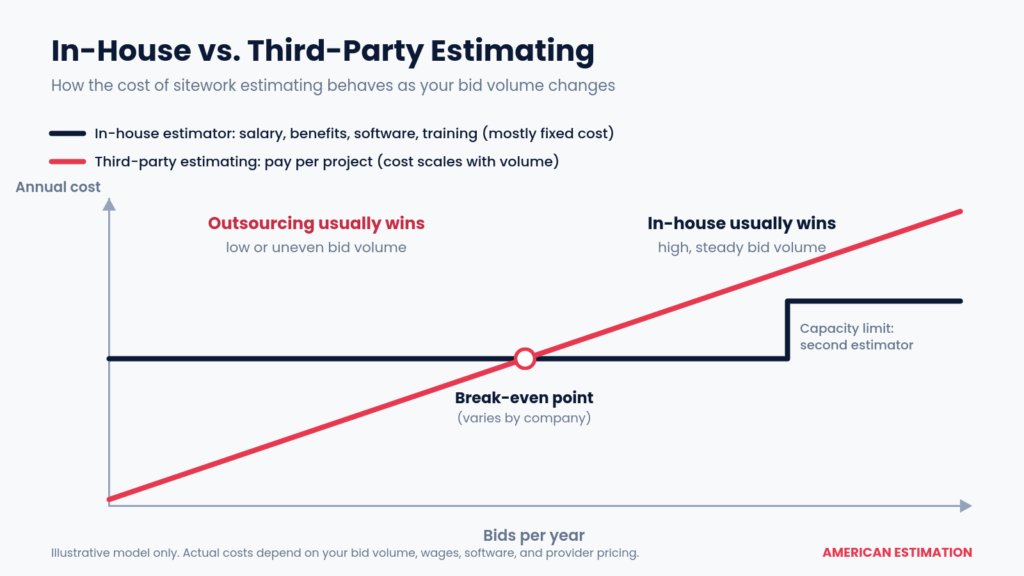
The simplest way to think about the cost difference is fixed versus variable. An in-house estimator costs roughly the same whether you bid five projects or fifty. Third-party estimating rises and falls with the number of projects you send. Somewhere between low and high volume sits a break-even point, and where it falls depends on your wages, your software, and the provider’s pricing.
In-House vs. Third-Party at a Glance
| Factor | In-House Estimator | Third-Party Estimating |
|---|---|---|
| Cost structure | Mostly fixed: salary, benefits, software | Variable: pay per project |
| Capacity | Limited by one person’s hours | Scales with your bid volume |
| Earthwork modeling skill | Depends on the individual and their software | Specialist focus on civil takeoffs |
| Local pricing knowledge | Strong | Stays with you, since you apply the pricing |
| Turnaround | Depends on current workload | Agreed per project against your bid date |
| Continuity | Disrupted by absence or turnover | Team coverage |
| Control | Full | Full over pricing and the final decision; quantities are yours to review |
How to Decide: A Practical Framework
Skip the gut feeling and run three quick checks:
- Count your real bid volume. How many sitework bids did you submit last year, and how many did you decline or rush because nobody had time? Count the missed ones too.
- Price the seat honestly. Add salary, payroll taxes, benefits, software, training, and overhead. Divide by the number of bids that estimator can realistically finish in a year, then compare that figure with per-project quotes at your typical project size.
- Check skills and risk. Who builds your surface models today? What happens to your bidding if that person is unavailable for two weeks?
| Lean toward in-house if… | Lean toward third-party if… |
|---|---|
| You bid sitework steadily all year, with enough volume to keep an estimator productive | Your bid volume swings with the seasons or your backlog |
| Sitework is a core, self-performed trade | Sitework is occasional or outside your core trades |
| You already have an estimator with civil and earthwork skills plus the software | Owners or project managers are doing takeoffs at night |
| Your pricing depends heavily on proprietary data tied to your own fleet | You are turning down or rushing bids, or want a second check on in-house numbers |
The Hybrid Model Many Contractors Choose
In practice, it is rarely all or nothing. A common setup keeps an in-house lead for pricing and strategy and sends the quantity takeoffs out, especially when the workload spikes or the job is large and complex. Small, quick-turn bids can stay in house, while the heavy civil packages go to a partner.
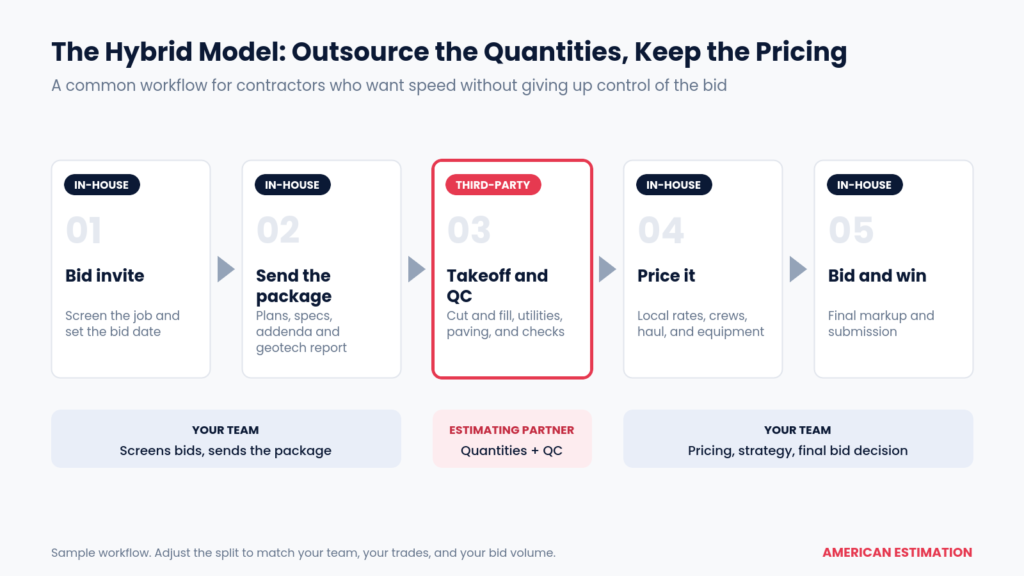
The benefit is speed without losing control. You get organized quantities quickly, then apply your own rates, crews, haul costs, and judgment before the bid goes out. For a broader look at this decision across all trades, read our comparison of outsourced and in-house estimating.
How to Choose a Third-Party Sitework Estimator
Not every estimating service handles civil work equally well. Evaluate providers on practical points, not price alone:
- Civil plan experience. Ask how they work through grading, utility, paving, and erosion control sheets.
- Earthwork method. Do they model surfaces or use grids and sections, and how do they apply swell and shrink?
- Clear deliverables. You should receive itemized quantities with units (CY, LF, SY, tons), assumptions, and exclusions in a format you can use, such as Excel or PDF.
- Addendum handling. Confirm how revisions are reflected and whether they are included in the quote.
- Quality review. Ask how quantities are checked before delivery.
- Turnaround. Confirm realistic timelines against your bid date, including rush requests.
- Communication and confidentiality. You should be able to ask scope questions, and your plans and bid details should be handled carefully.
- Transparent pricing. Look for a quote tied to your scope. You can see how ours works on the estimating fee page.
What to Send for the Best Results
The quality of a sitework takeoff depends on the information behind it. Send as much of this as you have:
- The full civil plan set: grading, utilities, paving, erosion control, landscape, and site details, plus the architectural site plan.
- Specifications for the relevant divisions, typically 31, 32, and 33.
- The geotechnical report and any soil boring logs.
- The existing topographic survey, in DWG if available.
- Every addendum issued so far.
- Your bid date, project location, and the scopes to include or exclude.
- Notes on haul routes, disposal sites, import sources, and how you want quantities organized.
Common Sitework Takeoff Mistakes to Avoid
Whether you estimate in house or outsource, watch for these:
- Applying no swell and shrink, or generic factors instead of the geotechnical report.
- Forgetting the topsoil strip and removal of unsuitable soils.
- Missing demolition, tree removal, and existing utility conflicts.
- Measuring pipe length without trench depth, bedding, structures, and surface restoration.
- Overlooking pavement layers and different thicknesses in different areas.
- Leaving out erosion control, dewatering, and temporary facilities.
- Mixing units, such as tons of asphalt and square yards of pavement, without checking conversions.
- Missing an addendum that changes grading or utilities.
For more on the pitfalls that cost contractors bids across all trades, see 8 common construction estimating mistakes, and for the basics of measuring from plans, see our complete guide to construction takeoffs.
The Bottom Line
There is no universal winner between in-house and third-party sitework estimating. If you bid sitework steadily and already have the people and tools, keeping it in house can be the right call. If your volume is uneven, your team is stretched, or civil takeoffs sit outside your core skills, a third-party estimator gives you accurate quantities on time without fixed overhead. For many contractors, the hybrid approach is the best of both: outsource the measuring, keep the pricing.
Frequently Asked Questions
Is outsourcing sitework estimating worth it?
It often is for contractors with uneven bid volume or limited civil estimating capacity, because you pay per project instead of carrying a fixed salary. Run the numbers against your own bid volume using the framework above.
Do I lose control of my bid if I use a third-party estimator?
No. You still set pricing, markup, and strategy. The estimating firm provides quantities and cost estimates for your review, and you decide what goes into the bid.
What do I need to send to start a sitework takeoff?
The full civil plan set, specifications, the geotechnical report, any survey data, all addenda, your bid date, and the scopes you want measured.
How does a takeoff handle swell and shrink?
The estimator applies swell and shrink factors by soil type, ideally taken from the geotechnical report, and lists them as assumptions so you can review or adjust them.
Can I use both in-house and third-party estimating?
Yes. Many teams use a third-party estimator for overflow, large civil packages, or trades outside their core experience, and keep smaller bids in house.
Talk to American Estimation
We deliver itemized takeoffs and cost estimates for sitework and earthwork and the other trades we cover, with pay-per-project pricing. Send us your plans for a quote, or review our estimating fees first.